

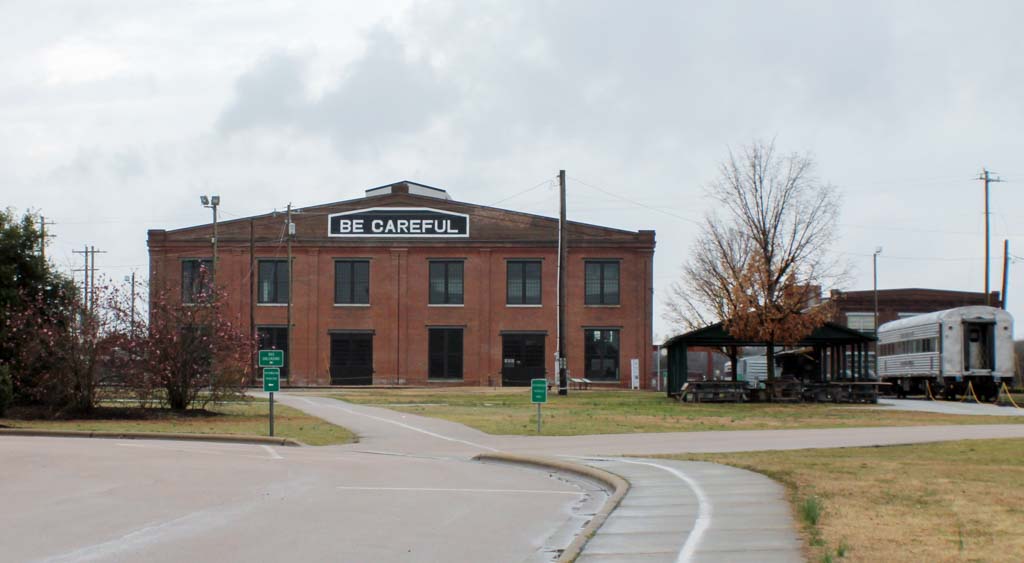
Spencer Shops underscores the importance of commerce and railways in the early-twentieth-century United States. The town of Spencer, North Carolina, located roughly three miles north of downtown Salisbury in Rowan County, is the midpoint between Washington, D.C. and Atlanta, Georgia, and was selected by railroad financier J. Pierpont Morgan as the site of the Southern Railway’s largest steam locomotive repair facility. Now a transportation museum, it is one of the nation’s few intact twentieth-century railway facilities.
In 1896, Southern Railway began construction on a 15-stall roundhouse with a 91-foot turntable, a small machine shop, and blacksmith shop. Over the next two decades, the facility expanded to include a boiler shop, powerhouse, two car repair sheds, a storehouse, paint house, and oil house. The facility was named in honor of the Southern Railway’s first president, Samuel Spencer.
The Back Shop, once the largest building in North Carolina, was built in 1904. The 150 x 600–foot steel-frame building with a Howe truss roof was enclosed in brick and glass. Electric lighting and hot-air heating set it among the most modern buildings of its time. The two-story brick structure with brick pediment and pilasters features a six-bay, north-south facade; the east-west facade is 24 bays long and also contains brick pilasters. The north end bears the painted sign, “Be Careful,” a call to protect a legacy as the fastest and most efficient shop in Southern Railway’s fleet.
In 1924, the 15-stall roundhouse was replaced with a 37-stall roundhouse and 100-foot turntable. At its peak during World War II, Spencer Shops employed 3,000 craftsmen, including machinists, carpenters, painters, and draftsmen, and could service 75 engines and 50 cars a day. The switching yards could handle 300 cars a day.
The success of the shops was short-lived, however, as the advent of the diesel engine quickly antiquated the steam engine technology. By 1949, Southern Railway had switched almost entirely to diesel, leaving no need for the 3,000 workers or the shops. The Southern Railway retired its last steam engine in 1953, initiating the decline of Spencer Shops. The facility served as a freight yard until the 1970s, when Southern Railway donated the site to the State of North Carolina, which opened the facility as the North Carolina Transportation Museum in 1983. The museum completed an $8 million restoration in 1996. Most recently, in 2017, the museum opened the 90,000-square-foot Back Shop, which has allowed for larger exhibits.