

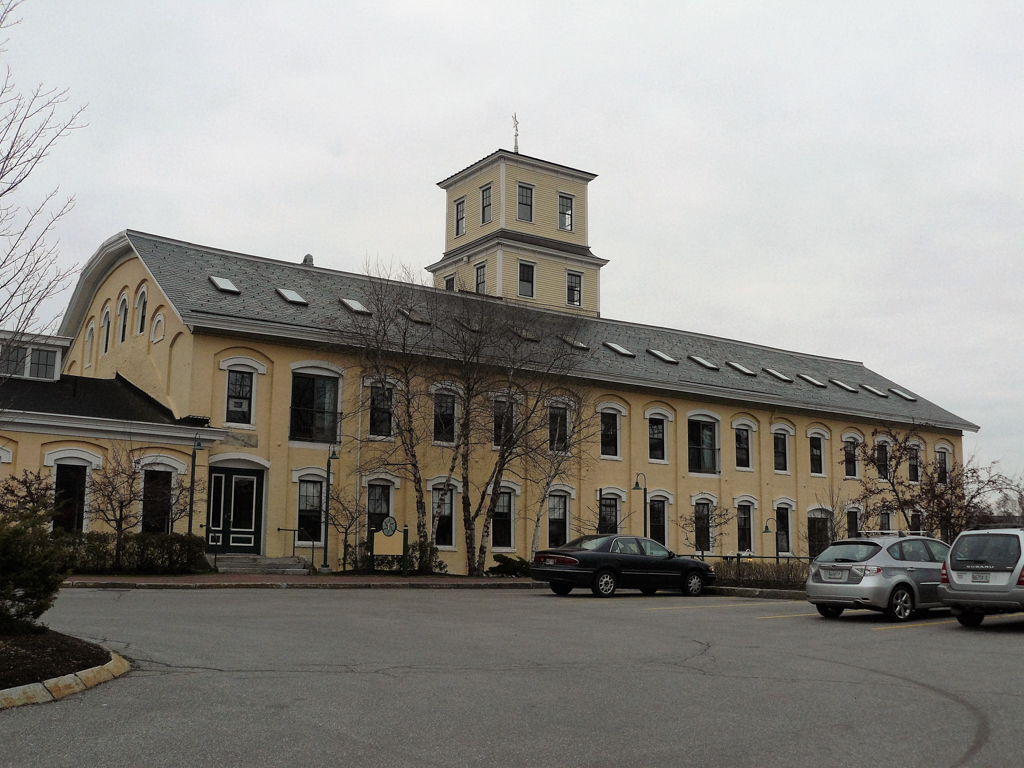
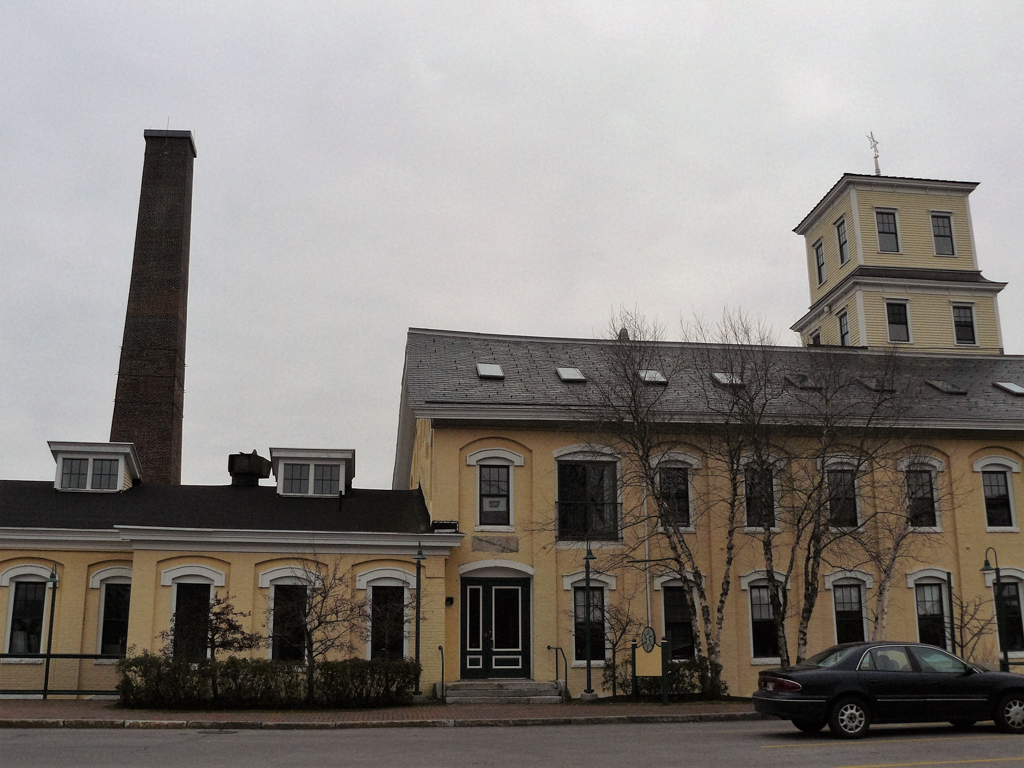
Located in Topsham at the falls of the Androscoggin River and across from the town of Brunswick, the Pejepscot Mill, erected in 1868, is not only significant for its exceptional mid-nineteenth-century industrial architecture, but also for being one of the first mills in Maine to utilize wood pulp in the manufacturing of paper.
The Pejepscot Mill presents a classic picture of nineteenth-century industrialism in New England. The large brick mill building was once part of a much larger complex of clapboard structures extending both north and west. The three-and-a-half-story Italianate structure rests on a granite foundation. It has a gambrel roof that spans the building’s entire length and breadth, but it lacks the wide eaves and paired bracketed cornice so typical of the Italianate style. The southern and most ornate facade of the building directly faces the river and is divided into eight bays of recessed brick panels with arched tops. The four central bays rise four full stories, while the two flanking bays are three-and-a-half and three stories, respectively. Within each recessed brick panel are windows with granite sills and Italianate arched eyebrow lintels; the detailing of the headers varies from story to story. The east and west facades are divided into sixteen, three-story bays of recessed brick panels with arched tops, and repeat the window pattern and design of the north and south facades. At the center of the gambrel roof, which contains sixteen skylights, sits a large, two-story cupola topped with a pinnacle. The first story is larger than the second, and each facade has two windows on each story, with surrounds supported by brackets.
Maine’s rich resources of water and forests of spruce and pine made the state a boon for pulp paper production. The Topsham Paper Company (later the Pejepscot Paper Company), run by Charles D. Brown and E.B. Denison, first operated in the basement of the Brown and Denison sawmill. Overexpansion and patent disputes ended the business in mid-1874. The mill was purchased in 1875 by the W.H. and A.W. Parson Company and reorganized as the Bowdoin Paper Manufacturing Company, specializing in wood-pulp paper production. Under Adna Denison’s control, Bowdoin Paper also operated facilities throughout Maine, in Portland, Mechanic Falls, Canton, and Norway. The Pejepscot Paper Company took over the mill after the Bowdoin Company failed in 1887, and continued operate the site to produce paper from wood pulp into the 1970s.
After 1900, with the rise of the giant International and Great Northern paper trusts, and newer technologies, papermaking increasingly gravitated away from falls sites to central locations such as Millinocket. The Pejepscot Mill ceased operation in 1980 and in the following years the moldering complex was vandalized; in 1998 the National Trust for Historic Preservation included the mill on its most endangered list. That year the Fore River Company of Portland, Maine, purchased the building and, using preservation tax credits, renovated it into a multi-tenant professional building with a restaurant (Sea Dog Brewery Pub). The restaurant preserved the heavy, original flooring, ceiling beams and supports, and other appurtenances of the paper mill, and also includes historic photographs of the complex. Most of the clapboard-sided industrial buildings of the larger mill complex were removed during the renovation. On the north side of the surviving brick mill building facing Bowdoin Falls is a new wooden deck used for restaurant seating in the summertime.