

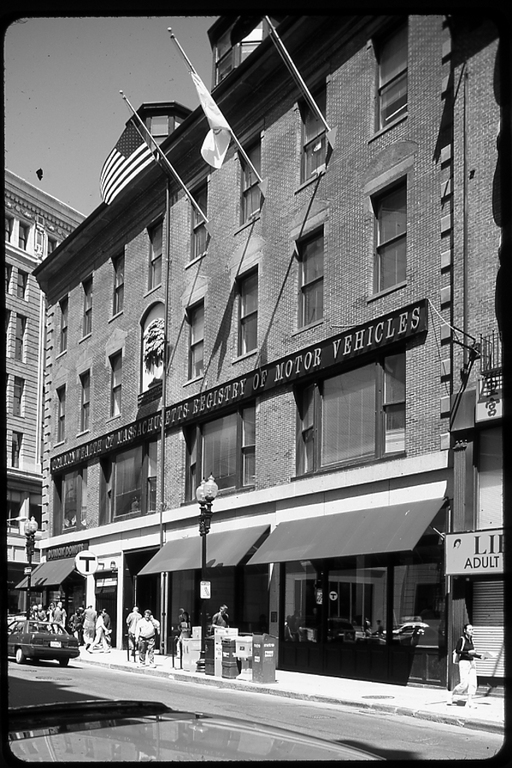
Nineteenth-century real estate developer David Sears pioneered in capitalizing on the nation's veneration for the Revolution, constructing this building on the site of the famous Liberty Tree, cut down by the British in 1775. The Liberty Tree was the site of many pre-Revolutionary activities, such as the Stamp Act rebellion, as noted in the August 14, 1765, entry in the diary of John Tudor: “This morning was discovered hanging on the great Trees [one of which would become the Liberty Tree] at the South end of Boston the Effigies of And[rew] Oliver esqr. as Stamp Master & a Large Boot with the Divel coming oute of the top.” Set within a brick arched niche at the third story, a commemorative wooden plaque carved in basrelief by Winsor and Brother, ship carvers, is inscribed with “Liberty–1765” across the top, “Law and Order” at its roots, and at the bottom, “Sons of Liberty, 1765. Independence of their Country, 1776.” Originally, Briggs' Bookstore rented the corner shop with the second and third floors designed for balls, levees, and public dinners. Sears correctly anticipated the direction of subsequent commercial development, as represented by the nearby 15–17 Essex Street (1875), an important example of the boldly articulated Venetian High Victorian Gothic style.
Liberty Tree Block
 Peter Vanderwarker or Antonina Smith
Liberty Tree Block
1849–1850, Greenleaf, Cushing and Adams, masons. 628–636 Washington St. 1875; 1998, Bergmeyer Architects. 15–17 Essex St.