Buildings in the Sudbury Center Historic District document the extended process of the separation of church and state in Massachusetts. The town built the First Parish Church (NRD) overlooking the Town Green in 1797 as the center for religious worship, town business, and munitions storage; adjacent horse sheds were built two years later. The oldest church in Sudbury is a white clap-boarded two-story building, three-bays wide, with a fanlight in the gable end and a three-stage tower and belfry. The meetinghouse became the focus of disestablishment tensions in 1838, when the legal opinion in the suit of Sudbury Inhabitants vs. Thomas Stearns determined that the parish, and not the town, controlled church records.
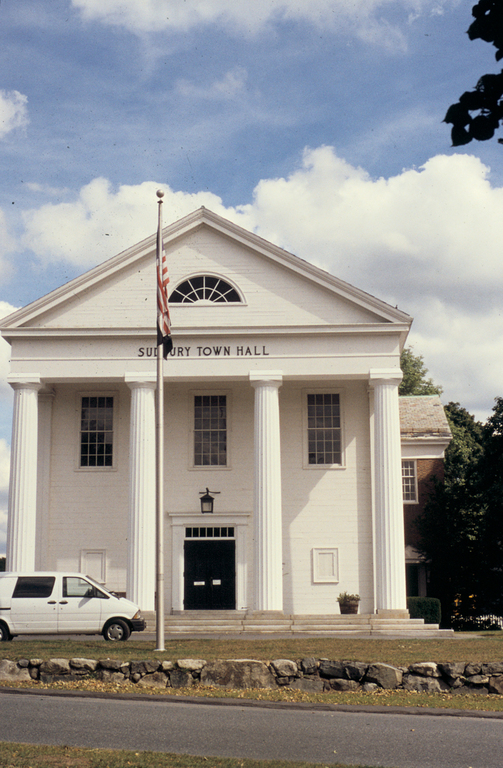
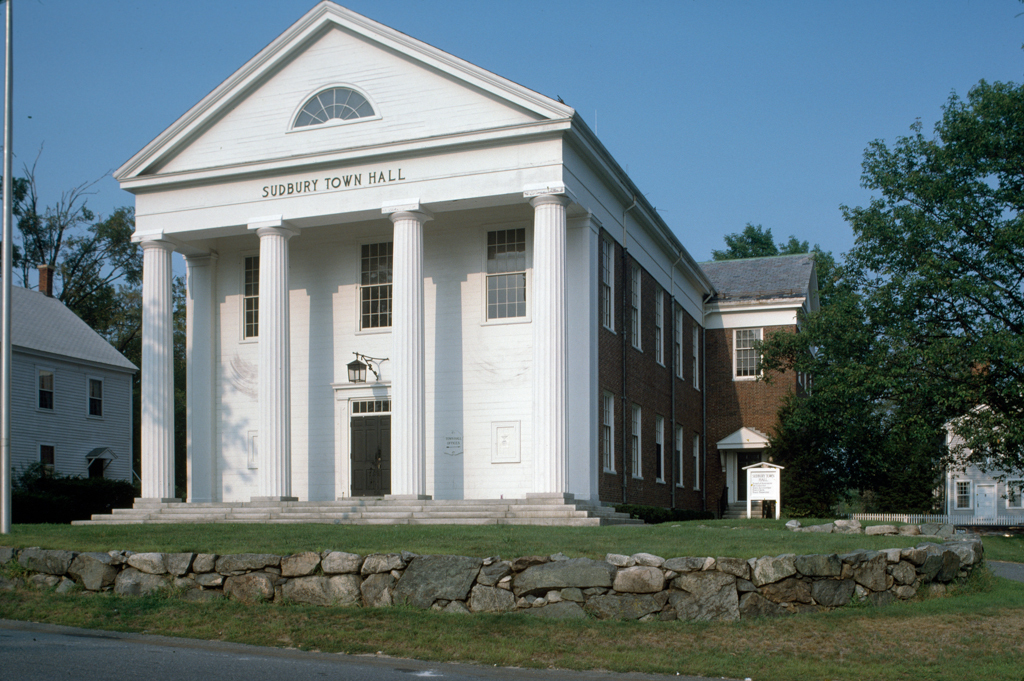
In 1846 Sudbury built a new town hall (322 Concord Road, NRD) across from the church. The town hall, a brick two-story temple-form building with a monumental Doric portico, burned in 1930 but was rebuilt two years later as an enlarged copy to the designs of Sudbury resident Charles H. Way. Also in 1846, the town built a two-story clap-boarded schoolhouse (originally located at the southeast corner of the Common and then moved to 324 Concord Road, NRD), which continued to serve educational purposes until 1890; the Sudbury Grange purchased the buildings the following year for their meetings. Another indication of the declining power of the old Puritan establishment in the early nineteenth century was the construction in 1835 of a Methodist church (330 Concord Road, NRD), adjacent to the schoolhouse. Expanded in 1896, that white frame church now serves the Presbyterian congregation of Sudbury. Substantial residences from the eighteenth through twentieth centuries extend from the Town Green in four directions.