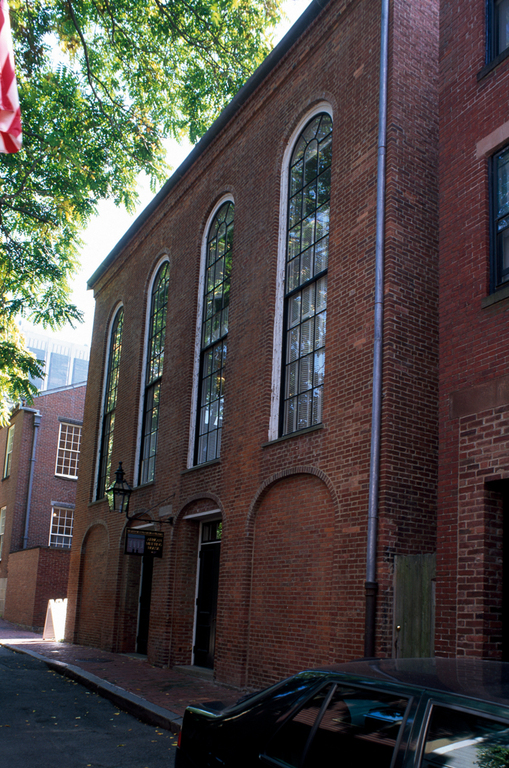
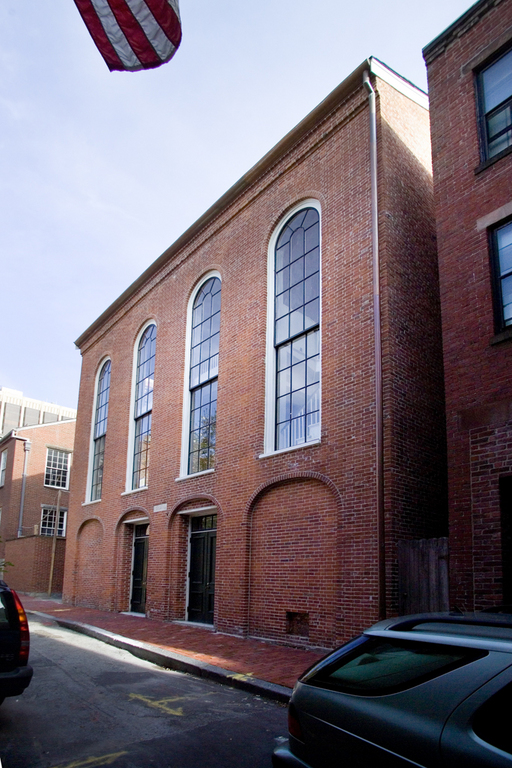
The earliest surviving Black church in the United States, the African Meeting House witnessed the birth of the antislavery movement in Boston and the nation. Encouraged by the white First Baptist Church, the Reverend Thomas Paul organized the Black members of that congregation into the First African Baptist Church, becoming its pastor in 1805. Although not documented, Asher Benjamin, architect for two recent Baptist churches in the city, may have provided the design for this spare four-bay brick building with double-level arched windows surmounting blind arches and doorways below. Black laborers and donations allowed the erection of the structure. In the tradition of a true meetinghouse, the building served the Black community for religious worship, political meetings, and education. In 1832, William Lloyd Garrison founded the New England Anti-Slavery Society in the meetinghouse; in the January 1, 1831, issue of The Liberator, he had asserted that “I determined, at every hazard, to lift up the standard of emancipation in the eyes of the nation, within sight of Bunker Hill and in the birthplace of liberty.” Its stage welcomed a pantheon of Black and white orators, including Frederick Douglass, Harriet Tubman, Sojourner Truth, and Maria Stewart. The four two-story windows of the main facade date to an 1855 remodeling. Anshei Libovitz, a Hasidic Jewish congregation, purchased the building in 1898 and adapted it as a synagogue in 1904. The Museum of Afro-American History acquired the building in 1972.

