

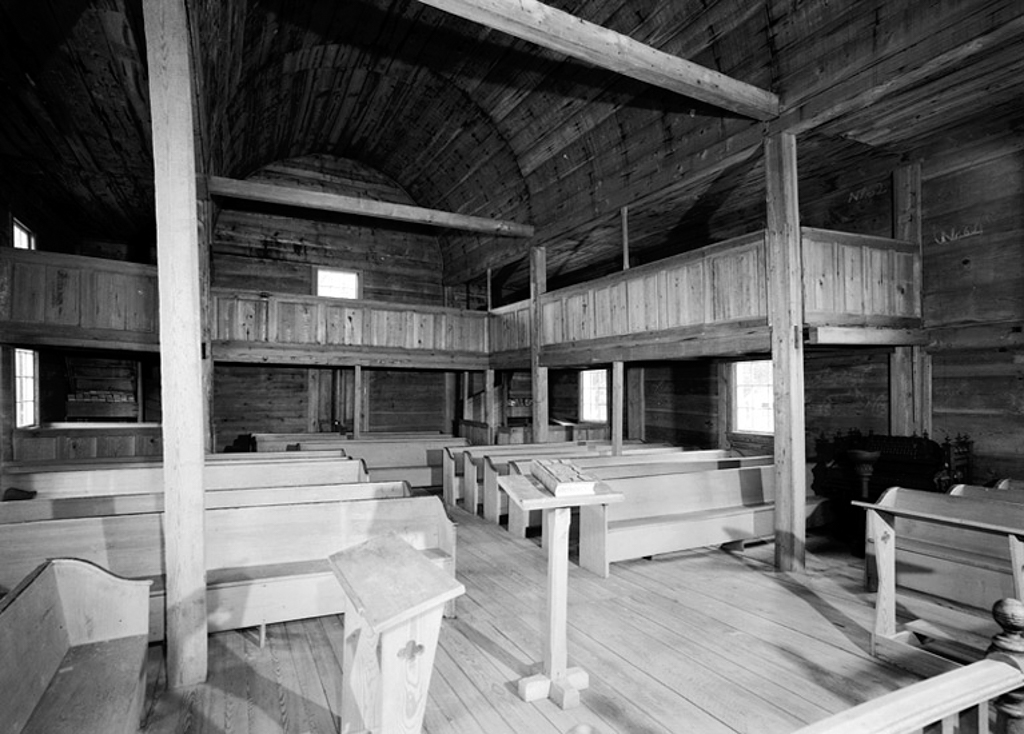
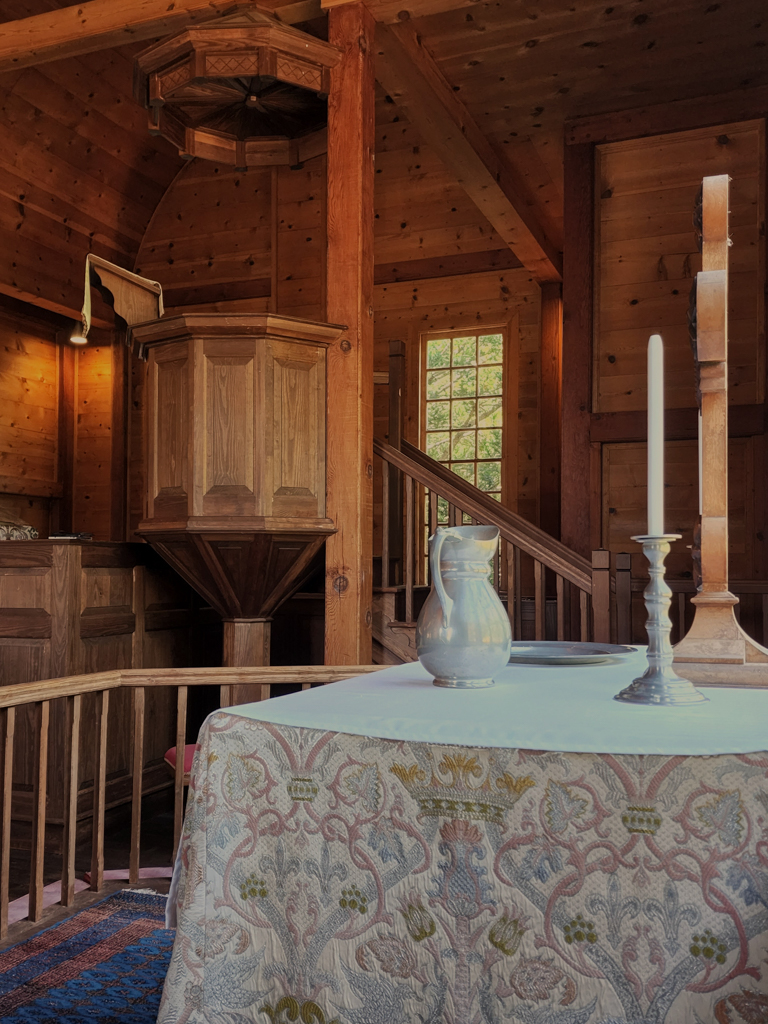
Named for the English prince soon to become King George III, this notable frame building was erected as a chapel-of-ease for Worcester Parish, Maryland, when the area was still part of that colony, in an oak grove at “Black Foot Town [Dagsboro] on the south side of Pepper's Creek” (Castrovillo, 1985). Two acres were purchased for 207 pounds of tobacco. James Johnson agreed to build the church for 39,200 pounds of the weed. Inside the barrel-vaulted nave (its ceiling is said to be a perfect semicircle) is a heart-of-pine interior, never painted. Galleries stood on three sides, and Daniel Hull was hired in December 1756 “to laying of the gallaries floors . . . and wainscoating the gallaries all round.” A T-shaped transept and chancel were added in 1763 to the east end. The church had deteriorated by 1850 and services were discontinued; during this decade, apparently, the transept was removed. But “Harvest Home” services opened the building once annually, and it was refurbished in 1893. The place was repaired and its walls shingled in 1928–1929. The Episcopal Church sold it to the state for a dollar in 1967. Subsequently, the missing transept was re-created, and the entire exterior and windows were renewed. Historian Richard B. Carter notes that the church was originally shingled, so that today's weatherboards are not historically accurate.
Prince George's Chapel
1755–1757. 1763. Vines Creek Rd. and Chapel Ln., Dagsboro