Saint Peter's-by-the-Sea Episcopal Church

Saint Peter's-by-the-Sea Episcopal Church

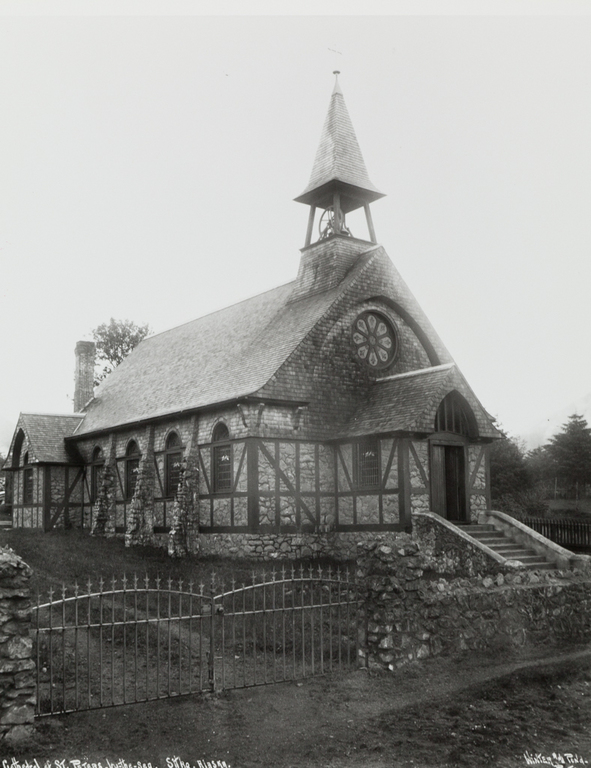
Saint Peter's-by-the-Sea Episcopal Church Alaska State Library, Winter and Pond

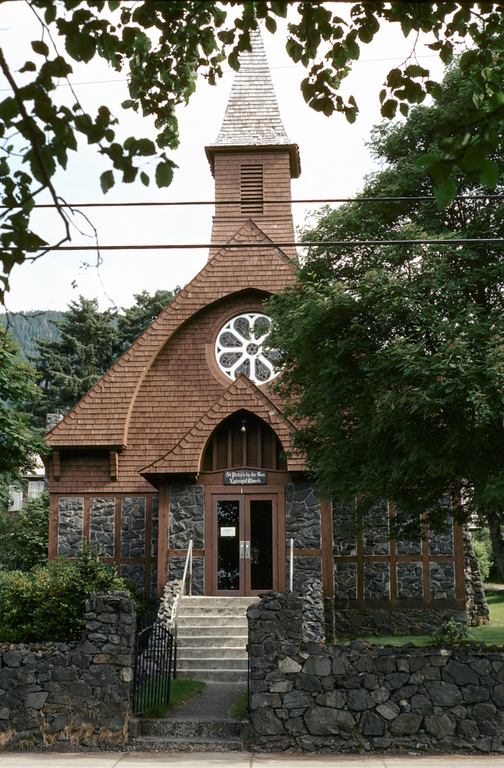
Saint Peter's-by-the-Sea Episcopal Church

Saint Peter's-by-the-Sea Episcopal Church
1899, H. L. Duhring, Jr. 611 Lincoln St.

The newly named Episcopal bishop of Alaska, Peter Trimble Rowe, had this church built in 1899. Rowe took ideas for its designs back east, where Philadelphian George C. Thomas, treasurer of the Board of Missions of the Episcopal Church, hired architect H. L. Duhring, Jr., also of Philadelphia. John W. Dudley supervised construction, which was completed by Thanksgiving 1899.

One of the few stone buildings in Alaska, Saint Peter's Church has the heavy timbering, random rubble stone, and wood shingling characteristic of small ecclesiological churches of the late nineteenth century. Set on a stone foundation, the church is constructed of a heavy timber frame, filled with rubble stone nogging. (The accompanying photograph is historic, probably taken soon after construction; at some time, all of the stone was removed and relaid, and some diagonal bracing was removed.) Stone buttresses help support the walls. Windows of the nave have round arches, and there is a rose window in the front gable, set in a large pointed arch framed by the gable. This motif—characteristic of many small Richardsonian churches—is repeated in the small vestibule directly below. A square belfry, now equipped with louvers, but originally open, rises from the front of the gable roof and is topped with a tall pyramidal roof. The shingles on the roof are unpainted, whereas the shingles covering the gable end and the sides of the belfry are painted brown.

On the interior, the ceiling is supported by exposed wooden scissor trusses. The dark wood diagonal boards of the ceiling contrast with the white walls. Stained-glass windows and the original wooden pews create a subdued atmosphere. The reredos, added in 1932, was designed by Lester Troast, an architect who taught at the Sheldon Jackson School before setting up his architectural practice in Juneau.

Writing Credits