

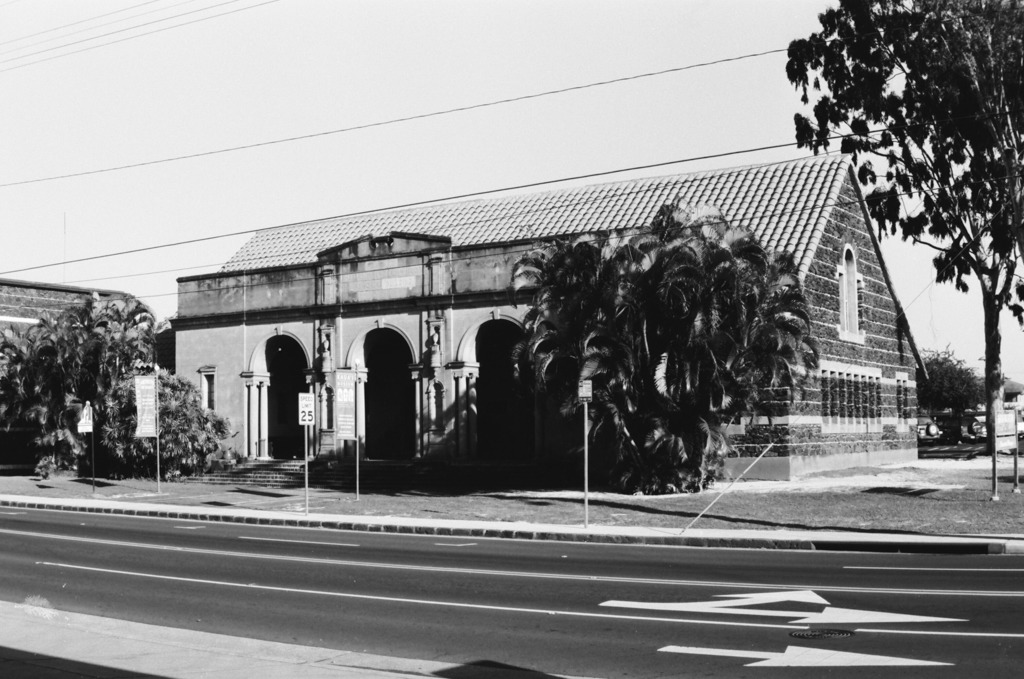
The Kauai Museum uniquely invokes Beaux-Arts classicism within a Hawaiian context. It strives to meld a variety of materials and two stylistic vocabularies, one Western, one Hawaiian, into a distinctly regional architectural statement. The projecting, concrete, Beaux-Arts entrance lanai, with three round arches, Ionic columns, niches, urns, and a broken pediment rising above a parapet, stands in formal contrast to the remaining lava-rock elevations. A large, steeply pitched, blue-tiled, gable roof contributes a third strong visual element. Palladian windows in each gable reinforce the facade's classicism, and the distinctive use of concrete stringcourses along with concrete window trims further formalizes the otherwise rustic associations embodied by the use of lava rock. In an “only in Hawaii” manner, the building captures the dignity befitting Kauai's first public library building, yet maintains an air of informality and hospitality which has been so much a part of the spirit of the Islands.
The building was used as a library until 1969, when it was replaced by a new library on Hardy Street (KA27). The 1924 structure was then remodeled by architect Geoffrey Fairfax into a museum, which opened to the public in November 1970. The two-story, lava-rock, modern box addition was constructed in 1960.